
Guide to e-democracy
We have the technology. We have the know-how. We just need you...
Learn more about the tools and concepts that will reform City Council towards a new era of politics and technology.
Contents
|
|
|
|
|
|
|
|
|
|
|
|
|
|
|
|
|
Introduction
This guide aims to inspire and reassure the residents of Ottawa that e-democracy is safe, cost-effective and important. The 'Case Studies' are drawn from the first-hand experience of e-participation in the City of Bristol in the United Kingdom. The U.K. is putting into practice e-participation. Couple that with the innovations around e-democracy from Team Patrick Paquette, and Ottawa will soon be placed on the map as a pioneering engine of e-democracy.
We now know that it makes no difference whether your ward or is large or small, urban or rural, excellent or not. We are certain that e-democracy offers a route into a new, more open and meaningful dialogue with City Hall, citizens, service users and communities.
Most ward leaders aspire to be “community leaders”, “listening councils” and “customer-focused.” Therefore, e-participation will almost certainly be high on their agenda anyway. This guide will simply help you to recognize how much more you might already know about the subject.
However, if your ward leader has none of these ambitions then you should carry on holding public meetings in draughty church halls, or community centres, on the same night as Hockey Night in Canada. Just don’t be surprised when your meeting is poorly attended or hijacked by one or two particularly disgruntled residents. At this point, we hope you might remember this was the time you could have voted for convenience. Just maybe you will be inspired to do something different and not vote for the incumbent.
Team Patrick Paquette is thankful to the Bristol City Council for the helping hand and coordination required in order to put together this guide and transcend our cultural differences. Together we shall be pioneers of e-democracy.
Section1 - Information, preparing for take off
The Municipal Freedom of Information and Protection of Privacy Act (MFIPPA ) came into effect January 1, 1991.
The Act gave individuals the right to access municipal government information, including most general records and records containing their own personal information, subject to very specific and limited exemptions. As well, the Act provides individuals with the right to request a correction of their personal information, which they believe to be false or inaccurate and/or to attach a statement of disagreement to their records. An individual is also provided with the opportunity to request an independent review from the Information and Privacy Commissioner/Ontario of the decisions made under MFIPPA by the head of an institution.
If you stop a council officer and ask for his or her view on whether the general public is sufficiently knowledgeable to offer a useful opinion on their service priorities they may laugh out loud. What’s the answer? Information that is not based in bureaucratic lingo!
Information is a precursor to involvement. But, nowhere in City Council Webcasts: Live and Archived, can you find the button to turn on the "bureaucratic filter". Without it, people will not listen for more than 1 minute. I absolutely do not blame them. If they do not speak the same language, then they will be alienated and won't recognize that they have the right to be consulted; they cannot participate in a meaningful way or respond to a consultation without an informative video proposal that is under 10 minutes, to the point, and contains information that speaks directly to them.
Consultees on the other hand are only too aware of the frustrations caused by being asked to respond to numerous consultations all at once. So common is this frustration that it has been given a name – “consultation fatigue”. Over time, consultation fatigue reinforces a belief that responding to consultations is a waste of time and effort. Consequently, response rates wither and trust declines
New technologies are having a huge impact on the way that information is produced and shared. In fact, the Internet has sparked an e-communications revolution that is no less radical in scope than the changes brought about by the invention of the printing press five hundred years before. I speak of Youtube, and it's powerful way to reach the residents in a familiar fashion, that is quick, to the point, and not bureaucratic.
We suggest that through the effective combination of mobile phone and familiar Internet mediums such as Youtube (cost-efficient) the City can directly reach the vast majority of their local populations.
1.1 Webcasting
The term “webcasting” derives from the phrase “web broadcasting”. Webcasts are like TV transmissions over the Internet. They allow multiple viewers to watch and listen to live or recorded events such as council meetings.
Webcasts make use of streaming technology. This enables users with the appropriate media player software to view the broadcast without having to download the entire file to their computers. As video files are large, streaming offers a user-friendly way to watch these files. The City of Ottawa has a 'Plug in to Your City" section on their website. However, as mentioned earlier, a streaming of the council proceedings is not our intention, nor is it suggested as an effective way to deliver transparency. Visit City Council Webcasts: Live and Archived and attempt to find the council debates and information on the Lansdowne Partnership Plan?
Webcasting doesn’t have to be complicated. Firstly, you need to broadcast the event live. Then record it and webcast it later as smaller segments under refined categories. An example of this live broadcast being disseminated into informative segments can be found at this popular American Internet Talk Show; The Young Turks. The live broadcast is > found here < and the searchable Youtube segments are >found here<.
Imagine if residents could access a 10 minute video segment on the different proposals for Lansdowne, without having to watch a 2 hour council debate full of bureaucratic lingo. The segments would contain the proposing commentary from each side, a cost or savings argument attached with a numerical number (average cost to taxpayer), and a feature to vote 'yay' or 'nay'. Majority wins. That is my vision for the future of this city. That is my vision for our politics.
Recently, portable webcasting packages (Podcasting) have been developed and it is now practical for community meetings held outside of council premises to be webcast. This makes webcasting a useful tool for community groups and partnerships that want to reveal themselves to the wider Internet world.
This system of e-democracy coupled with webcasting would allow these community groups, businesses, and individuals to create their own video proposal to the entire citizenry of Ottawa. My staff will aid in the creation of these videos, and the fact and figures from the proposals will be strictly analyzed. Fallacious proposals would be filtered from the system. Quality of information is key. The system does not allow for a free-for-all of proposals. Proposals must be within the realm of municipal jurisdictions.
Case Study, North Lincs. Housing Transfer
As part of the Local e-Democracy National Project, North Lincolnshire Council webcast a meeting debating whether to transfer the entire housing stock to a housing association. This was the first meeting the council broadcast live on the Internet. The meeting was also relayed live to a screen in a local school where members of the public could view proceedings. Viewers of the webcast could email questions to councillors, who responded to some of these issues during the meeting. Six hundred and seventeen people tuned in to watch the debate live. The archive broadcast of the meeting has been accessed over four hundred times since the debate.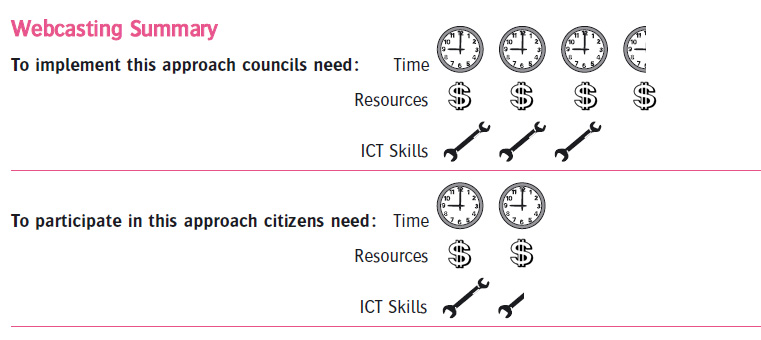 The potential for impact of this approach on:
Information High
Engagement Medium
Decision making Low–Medium
Google this “Streaming Council Video” “Public-i” "CPAC Live" "The Young Turks"
1.2 SMS and email Alerts
Many people don’t take part in council consultations simply because they don’t hear about them. When people do take part, a lack of feedback puts many people off taking part again. Fewer and fewer people read their local newspaper and only a dedicated minority regularly browses their council’s website. A Short Message Service (SMS) using mobile phones or email alert system can help publicize your consultations, provide feedback and boost response rates.
It is now fairly common for football teams, weather channels, job bulletins and TV shows to invite audience members to sign-up for email or SMS alerts.
Alert systems link an electronic data source, eg. the council’s web site, to a means of sending out information eg. e-mails. Subscribers normally use the council’s website to register for alerts by creating a user account with an email address and their names. We suggest that users be able to set preferences for the type and frequency of information they want to receive, for example, a daily update or a weekly summary. Whenever the data source is updated, new information is automatically sent out to all who subscribe.
Many councils currently shoulder the administrative burden of maintaining a database of consultees. With our system of e-democracy, the onus is on the customer to update their email address and the information they want to receive. At practically zero distribution cost, the system dispatches information to people who want it – very useful and very sustainable.
Case Study, Kirklees Alerts
Kirklees Council launched its “Kirklees alerts” service in April 2005. Users can receive information about jobs, public consultations and planning applications by email, SMS or both. Subscription is free and the council are continually looking for opportunities to extend the range of information on offer. Events around Kirklees and emergency announcements are being considered at the moment.
The “My alerts” section allows subscribers to choose what information they are interested in receiving. They are also able to choose from a wide range of criteria relevant to the subject. For example, for planning applications the user can specify an application number, the applicant or agent name, a postcode, street, area or an electoral ward. Promotion of the service is limited to the council's website. Since its launch, over 2,900 people have subscribed. The majority of subscribers have signed up to receive email alerts, with 37% choosing to have information sent to them via SMS.
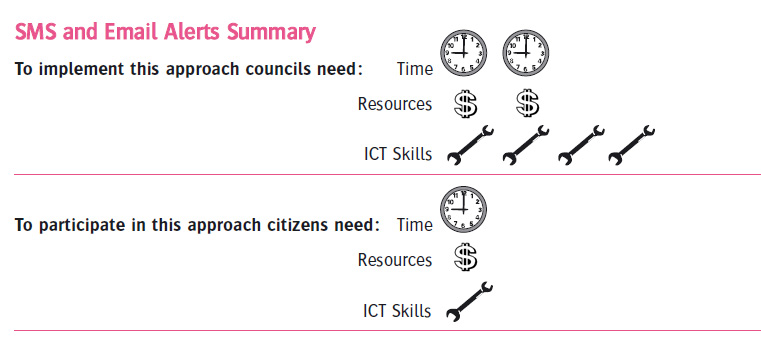
The potential for impact of this approach on:
Information Medium–High
Engagement Low
Decision making Low
Google this “Google alerts” “BBC news desktop alerts” “info4localgov” “local alert” “guardian jobs”
1.3 Consultation Finder Database
The City Council needs to grasp the advantages of public engagement. Citizens who vist the Public Consultation webpage will be surprised to learn just how much public consultation is carried out. Planners, policy officers, social workers, housing officers and a wider variety of professional groups routinely engage the public in consultation. But, unless their efforts are effectively coordinated to include the creation of a quick and informative video proposal, they may be wasting precious time and scarce resources. This is where consultation databases populated by online videos can be advantageous to the consultation process.
A consultation database or “consultation finder” acts as a central repository for consultation knowledge. Consultation databases can be internal, hosted on an Intranet but arguably are most effective when the information they contain is made publicly accessible via a website. The added “incentive” of public and stakeholder scrutiny means that records and videos are more likely to be kept up-to-date and in many cases, there is an opportunity for the person accessing the information to go on to participate in the consultation and video proposal creation process .
Once a consultation is complete, the database should be updated with a short 1 minute video summary of the consultation results. In time a URL will be added, linking to a set of committee meeting minutes showing what decision the council eventually reached.
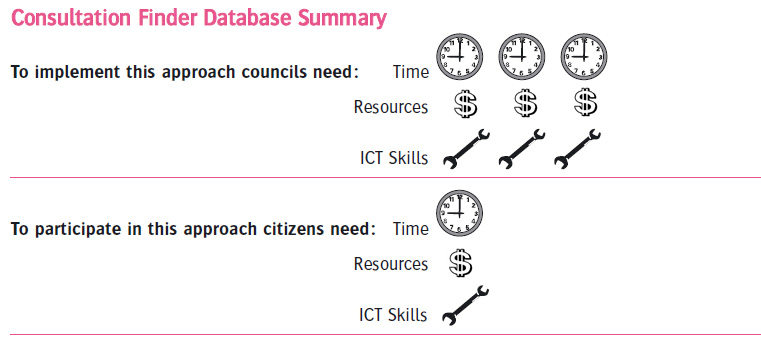
1.4 Games and Simulators
Every parent knows that children learn through play. But it is not only children who can benefit from the “light-hearted approach”. Through virtual role-play
citizens can gain insight in to the difficult choices that decision-makers face; they can
trade-off competing priorities and attempt to make the council’s books balance.
Organizations such as the BBC produce a range of online educational games aimed at young people, particularly through schools and there is increasing evidence to support their usefulness in the classroom. A small number of specialist companies are developing similar tools that councils can put to wider community use via their own websites.
Some games rely on quick decisions being made which helps focus attention. Others allow participants to compare scores with their peers, which increases enthusiasm and leads to greater participation.
Not all games are aimed just at young people. Budget simulators are designed to provide an easy introduction to complex council financial information, which needs to be understood before participants can make an informed response. Typically, budget simulators encourage people to review proposed budget figures for different service areas; read a description of what these services do and then experiment by increasing or decreasing budgets on an incremental basis, eg + or – 5% or 10% for social services. More advanced simulators show people the consequences of their actions either by demonstrating the impact on council tax levels, or by rejecting proposed changes until the overall budget balances.
Although games and simulators may allow participants to leave comments, and general patterns of response may be analyzed, their real strength is in developing understanding. If combined with an online survey or discussion forum, they may also become a genuinely useful and novel consultation tool.
Case Study, Bristol’s Budget Simulator
Between February 8 to April 30 2006, Bristol City Council invited members of the public to take part in a budget review that included the council’s budget meeting being webcast, an online discussion forum and a budget simulator.
The budget simulator was designed by Delib to encourage citizens to interact with the budget decision-making process. It took them through the different stages of the budgeting process and allowed them to allocate budget resources and experience the outcomes of their decisions.
The simulator allowed participants to review the data by department. The role of each department was explained in brief including priorities for the forthcoming years and an example was given to provide guidance on costs for particular services. The participants were able to amend each department’s budget by increments of 5% and were then invited to comment on their proposed changes. Potential participants were told that the
exercise would not influence the budget for 2006–2007 but would be taken into account for future budgets.
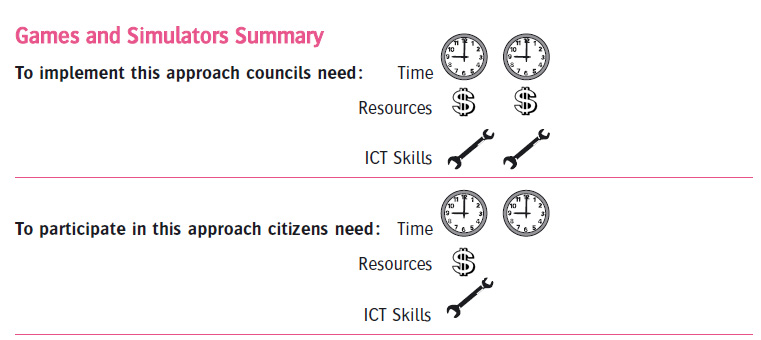
The potential for impact of this approach on:
Information Medium
Engagement Medium
Decision making Low–Medium
Google this “demgames” “captain campaign” “councillor quest” “e-democs” “delib” “radioactive waste
management game ITC” “pimp my party”
Section2 - e-consultation, revving the engines
Councils sometimes confuse information with consultation. If a decision has already been taken then whatever happens next can only be ‘for information’. Consultation takes place when there is still a real decision to be made based on a choice between different possible courses of action.
Some may see this confusion as desirable. However, implying choice when in reality the matter is closed does no one any favours (especially politicians). The public are increasingly media savvy and can smell a CON-sultation when they see one. Scrutiny and audit requirements mean that if consultation is deemed to be of insufficient quality, there is a high risk that authorities will have to rip it up and start again. It is best to be
honest and open. If there is no will or no space to consult then just say so.
Fortunately, the vast majority of council consultation is genuine and it is increasingly professionally managed. Councils use a wide range of tried and tested consultation approaches such as sample surveys, citizens’ panels, in-depth interviews, focus groups and public meetings to collect and analyze citizens’ views. So what can e-consultation possibly add to this repertoire?
E-Consultation is often seen as faster, more efficient and more cost effective than traditional consultation methods. And it is certainly true that savings in time and resources are there to be made. Electronic distribution of consultation documents saves on expensive printing, stuffing and postage costs. Encouraging respondents to complete surveys online saves on cumbersome data entry. Arranging online focus groups, particularly between geographically dispersed participants, will often be quicker and easier than arranging the real world equivalent.
However, e-consultation is not simply about saving time and resources. It is also about reaching out more widely to increase the breadth and depth of consultation, resulting in more citizens feeling more engaged.
We cannot underestimate the extent of civic disengagement in many sections of the community. And so, council needs to use all of the mechanisms at their disposal if they are to promote inclusive engagement and create strong, confident communities.
It is also true that “time-poor” citizens for whom work, study and shopping are likely to take precedent over attending a public consultation meeting in a draughty community centre or church hall, increasingly expect e-consultation methods. After all, who queues in the bank instead of using the nearest cash point unless they really have to?
The following section describes different approaches to e-consultation. Many are easily understood as they simply take a familiar consultation method such as a survey and transfer it to the online environment. However, even when the method appears familiar, the impact of moving it online can sometimes be surprising.
2.1 Quick Polls
Quick polls are a mildly engaging introduction to the world of e-consultation. As the name implies, quick polls are fast. They invite off-the-top-of-the-head responses to simple questions such as, “How do you rate this web site?” or “Isn’t the Chief Executive fantastic?”
Quick polls are the virtual equivalent of lifting a finger in to the air to see which way the wind is blowing. The results do not have the rigour of more structured e-consultation activities. However, a topical, regularly updated quick poll, positioned at prominent positions within the video proposals page will entice web-users to linger for longer and will foster a sense of engagement with even the most static council web site.
One or two mouse-clicks are all that is required to select and submit an answer to a quick poll. In return, there is instant gratification in the form of a pie chart or bar graph displaying the current result of the poll and usually, the total number of participants to date.
Quick poll applications calculate results based on the total number of participants in the poll. To be effective, quick poll questions must only require a single answer option (tick one) rather than be multiple-choice (tick any). For example, this is a good single-answer quick poll question – “How often do you visit this web site?” – every day, at least once a week, once a month etc. The following question might be answered with multiple
ticks so would not work as a quick poll – “Which of these services do you use?” – library, parking, schools, housing benefits etc. All these questions can be asked while the resident is viewing a proposal video that is of high concern to them.
Case Study, Bristol’s Quick Polls
Bristol City Council developed a quick poll facility for its website in early 2002. Since then, the council has posed over 40 questions to the public on a variety of issues, some deadly serious and others more light-hearted. Externally, the council uses its quick poll facility to draw attention to consultations or major projects it is undertaking or has just completed. For instance, a quick poll was used to ask people about tall buildings;
this was an easy and fun way into the consultation and included a link to the main survey.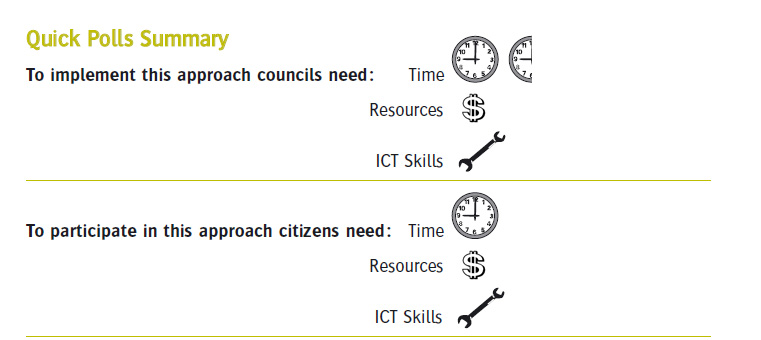 The potential for impact of this approach on:
Information Low
Engagement Low–Medium
Decision making Low
Google this “Opinion power” “snap poll”
Examples www.adur.gov.uk/polls/index.htm
2.2 Online Surveys
Online surveys bring major benefits to council in efficient data processing and simply represent an increasingly preferred way for people to participate.
Online surveys allow respondents to give their opinions to a consultation online. At a basic level, question and answer options are presented in a vertically scrolling page.
With a growing number of respondents likely to have Internet access, the ability to respond to a survey online will now be expected by the majority of respondents. Online surveys can facilitate higher response rates if they are coupled with topical images and videos. Do you know the boundaries of your ward? Do you know where Kettle Island is? When asking about specific topics, the survey needs to be interactive. Images, google maps, videos, any multimedia medium will place the citizen at the location in question. This will undoubtedly yield sincerer responses. The age of the bland bureaucratic survey needs to pass.
Compared to analyzing paper surveys, online survey analysis is a dream. Gone are the days of wading through hundreds of paper surveys, inputting them and waiting for the data file. When the survey closes, the first results from an online survey can be available within minutes.
Online surveys and e-democracy can be left open for anyone accessing the web anywhere to respond to. In which case, it is sensible to include a question about whether people live, work or study in the local area or elsewhere
Case Study, Height Matters
Height Matters was a planning consultation about the future construction of tall buildings in Bristol. It was a landmark consultation for Bristol City Council, as 85% of the 1000+ responses that we received were made online.
The online survey was step-through with plenty of pictures to get respondents thinking. It was hosted on the council’s website amidst professionally designed pages providing background information. The online support for the consultation was further enhanced by a deliberative poll, e-decide, looking at both sides of the issue. At every opportunity the online survey was promoted on the website and offline via flyers and posters.
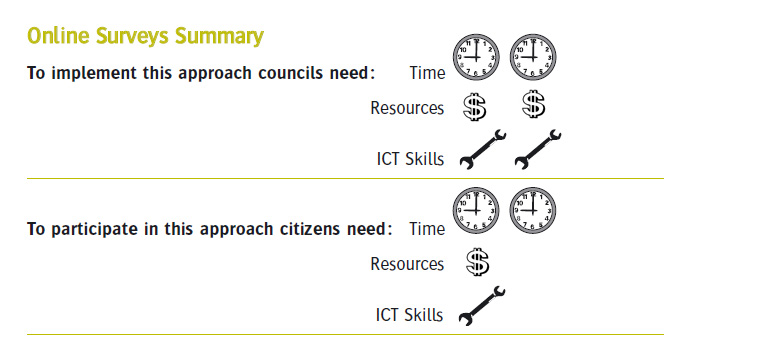
The potential for impact of this approach on:
Information Low
Engagement Medium
Decision making Medium–High
Google this “SNAP Mercator” “SPSS” “Key Point” "surveyclip"
2.3 E-Panels
E-panels are a way for councils or other organizations to carry out regular online consultations with a known group of citizens.
The most well established e-panel is YouGov, established by a market research company in 2000 to provide research for public policy, market research and stakeholder consultation.
Council can adopt this idea to have a way of consulting a group of people on a regular basis using a range of technology. It provides a quick and potentially cheap way of staying in touch with a group of citizens and of hearing their views.
Interactive technologies such as discussion forums or VIP messaging help to create a sense of online community and enable e-panel members to participate in the consultation process, suggesting topics for discussion that the council might not have considered. Enabling e-panel members to communicate and deliberate with each other as well as with decision makers allows a more informed response from participants and increases input into local authority decision-making.
E-panels can be run alongside traditional offline activities and their strength is seen to be as a way of increasing participation in local democracy. By providing information and consultations in easy to manage portions, people can dip in and out, participating at a time and place that suits them. When the council sets new issues, emails are sent to e-panel members encouraging their participation.
Feedback is an essential part of the e-panel process. Results and feedback will be published openly to participants to encourage their ongoing involvement. E-panels have the potential to enable local authorities to reduce their administrative costs and populate the list of online proposals.
Case Study, Wolverhampton Partnership
Wolverhampton’s Local Strategic Partnership established an e-panel in early 2005 to provide a way for all members of the partnership to gain community input through online consultations.
After the first year, three hundred and sixty people had been recruited to talk about issues from baseball caps and hoodies in shopping centres, to what issues scrutiny should consider and to participate in activities like a “Talk to your police chief” live chat and a webcast of the annual council meeting.
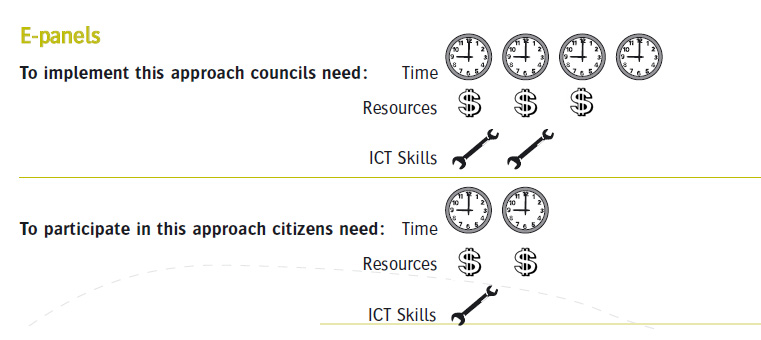 The potential for impact of this approach on:
Information Medium
Engagement Medium–High
Decision making Medium–High
Google this “e-panels” “YouGov”
Section3 - e-democracy, learning to fly
If consultation offers a choice between two or more pre-determined options, participation offers greater say in the options that are being consulted on. For many community engagement professionals, genuine participation is the ultimate goal and consultation will only ever be “participation-lite”. However, such a view fails to understand that both consultation and participation have their place in the workings of busy city councillor.
The main difference between consultation and participation is how much freedom or willingness the councillor has to relinquish control over the outcomes. Consultation on known options will, of course, deliver no surprises. On the other hand, participation may result in ideas or options that the councillor has not considered. This can be enlightening but some ideas may prove impractical or will be unpalatable to local authority decision makers. Therefore, for participation to deliver tangible benefits for all, it is particularly important that participation exercises are underpinned by good quality information setting out known opportunities and constraints via video introduction of the municipal jurisdiction. Some people confuse the lines between municipal, provincial, and federal. To which I say, OF COURSE THIS WILL HAPPEN!! Unfortunately, the 'powers that be' have made politics purposefully complicated. All it takes is a simple preamble video explaining to residents that municipal services fall within the realm of policing, water, transit, snow removal, garbage and recycling, sewers, fire and paramedics.
By using technology to make the process more manageable and more convenient for the time-poor, e-participation can open up the debate to people who would not be able to participate otherwise. But this is not the end of the story.
Participation is frequently based on passion; strong feelings or first-hand experiences leading to a desire to bring about change on an issue or in an area. Technology can help channel this energy in a constructive way using multimedia videos. Without this direction, strong feelings can easily turn to frustration and leads to anger and conflict simply because the 'powers that be' require them to read a 20 page memo filled with bureaucratic lingo. Through e-participation, people who feel strongly about an issue can seek out each other, whether they live in the next street, town or country. They can make contact and try to move things forward. Some will succeed, some won’t but if nothing else, participation is about trying and equal chance.
We need council to act as community leaders. Active listening is central to successfully fulfilling the community leadership role and fortunately, e-participation is here to help.
3.1 E-Petitions
Governments have kindly allowed citizens to voice opinions through petitions. E-petitioning brings this ‘human right’ into the twenty-first century. E-petitions can be started, read and signed on the web. An e-petitioner application is used to create and host e-petitions that could be propagated through the petitioners personal online social media.
E-petitioning coupled with social media offers greater opportunity for informed debate, provides increased transparency in decision-making and can lead to sustained community engagement.
The e-petitioner application is easy to use but every e-petition needs to be checked against an acceptable use and jurisdiction policy before it can be made live.
Once visible on the e-petitions web site, petitioners send it to their immediate preferred social media. If the subject at hand gains momentum, then people can show support by adding their name, e-mail and postal addresses to the e-petition.
When someone signs a paper petition this is usually the end of their involvement. E-petitioning is more engaging and is habit-forming. If someone is uncertain about supporting an e-petition they can email the owner for clarification. Supporters can also interact with the e-petitions web site and respective online video proposal. If someone strongly disagrees with the e-petition they can say so online or even start a counter e-petition with a competing video proposal.
Following an e-petition’s close, a report is produced setting out the number of signatures, their reliability and summarizing discussion comments for and against. Feedback on the results of e-petitions should always be published on the council’s website via a short video. Councilors can successfully use e-petitions to raise the profile of policy issues affecting their wards.
Case Study, Bristol’s e-Petitions
Bristol City Council offers public access to most committee meetings and has a well-developed consultation strategy. The council began using e-petitions in 2004 as a way of extending democratic arrangements. The council worked with Napier University to adapt the Scottish Parliament’s e-petitioner. Bristol and Kingston became the first UK local authorities to pilot this approach.
Between September 2004 and July 2006, Bristol received 39 e-petitions with more than 10,000 people taking part. Subjects have ranged from ID cards to bridge closures, pedestrian crossings to street art. The e-petition attracting most support concerned plastics recycling. More than 4,600 people signed this e-petition in just 11 weeks. What’s more, it was started by a councillor and responded to by an Executive Member from the same political party. Monitoring shows that e-petitioning is used by men and women, the young and old from all parts of the city. Many say they have never signed a petition before.
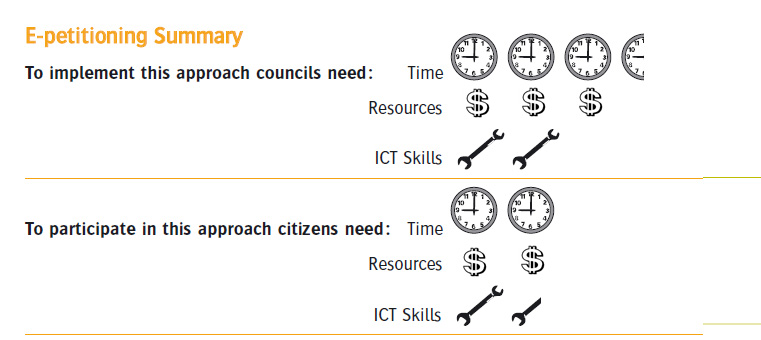 The potential for impact of this approach on:
Information Medium
Engagement Low–Medium
Decision making Medium–High
Google this “Epetitions” “International Teledemocracy Centre”
“Ann Macintosh”
3.2 Pledges
Pledges are a useful tool for citizens who feel strongly about particular issues to take action without the fear of being the only person to do so. The aim of pledgebank.com is to help citizens overcome feelings of powerlessness by connecting them with other people who also want to bring about change. Tools such as pledgebank.com enable individuals to build communities and networks around issues, recognizing that groups of people can achieve more than an individual. Attaching online pledge banks to social media and local community organizations can have a definitive impact on the city and residents of Ottawa.
The way pledges work is very simple. A citizen can start a pledge on any issue, specifying an action they will take if a specified number of other people agree to take similar or complementary action. For example, you could pledge to write to your local council about a particular issue but only if 20 other local people do the same, or you could pledge to organize an event or rally but only if 50 people agreed to attend. Other members of the public can then sign-up to support the pledge and/or leave comments, thus encouraging debate around issues, as well as action. The strength of social media will keep the pledge alive until it is complete.
Pledges are about people taking action and getting things done by organizing collectively. Within this scope, the applications of pledges are limitless. Example pledges on pledgebank.com include: a business in Rutland promising that it will recycle all its waste paper, but only if 3 other local businesses do the same; a library user who promises to set up a British Library users group, but only if 20 more people promise to join the group.
Pledges are a flexible and inspirational way of encouraging citizens to engage in their local community. Pledges can include things as diverse as organizing groups or events, writing letters to decision makers, engaging in direct action (eg protests or rallies), changing behaviour (eg recycling or using sustainable energy), and making charitable donations (in terms of either time, money or skills).
Whilst there is no guarantee that citizens will fulfill the pledges they make, it is likely that fostering networks between people with common concerns acts to motivate people who may otherwise feel disinclined to take action alone. Indications are that pledges are successful in achieving this aim. For example, pledgebank.com surveyed a collection of financial pledges and found that typically three quarters of people fulfilled their pledge.
Case Study, Pledgebank
The pledgebank.com archives contain information on successful pledges ranging from campaigning for vegetarian marshmallows to protecting civil liberties. Pledges have been set up on local, national and international issues. An example of local government related pledges is a Brixton resident who pledged to
“send my newly elected councillor an email using www.writetothem.com asking that they review their current policy regarding the fencing off of events in Lambeth Parks but only if 15 other local people will too”.
The pledge creator provided background information on Lambeth council’s policy of requiring events attended by more than 2000 people to be fenced off and how this had deterred organizers of free/charitable events from holding their events in Lambeth parks. 25 people signed-up to the pledge (10 over target), thus highlighting this particular pledge as a successful example of how pledges can be a useful tool at engaging citizens with local issues.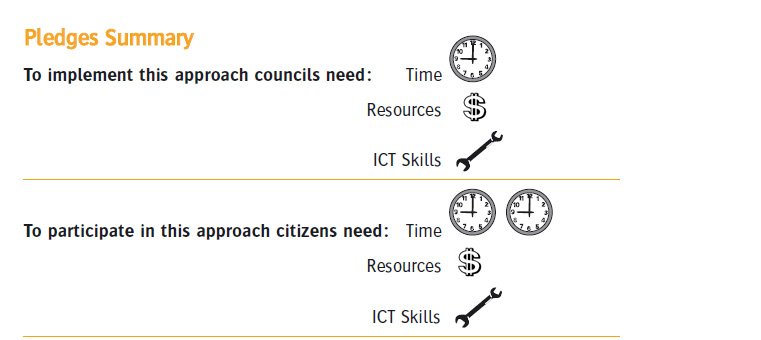 The potential for impact of this approach on:
Information Medium
Engagement Medium–High
Decision making Medium–High
Google this “Tom Steinberg” “My Society”
3.3 Online Video Proposals
It is not just what people say that is important, but also how people say it. Video Consultation projects are a powerful tool in humanizing the consultation process and allowing people to express themselves and their opinions outside of the constraints of traditional and formal consultation.
With the emergence of vlogging, the creation of video content by everyday citizens is a growing phenomenon. Citizens are using web-based applications such as YouTube to upload and view video clips on subjects as diverse as fly-fishing, line dancing and local democracy. YouTube has said that its users are now watching more than 100 million videos per day.
Online Video Proposals encourage citizens to engage directly with their community and the council by making use of increasingly commonplace technologies such as video cameras, web cams and mobile phones. Video is an exciting and engaging medium that has the advantage of giving citizens editorial control over how their voices are represented. My office and my team have the necessary tools and editing skills to allow residents and community organization, who might not have the ressources or technical know how, to express their video proposals online. After all, we are in the business of multimedia and online solutions!
We have developed the requirements for the creation of a web platform that allows for the viewing of video proposals. Ultimately, these are the videos that the residents will be voting on. Obviously some videos will carry more popularity then others, (such as major infrastructure projects) but that is the only way to gauge the collective 'Will of the Majority' and find the threshold of true value for money!
Video can be used by citizens in a variety of ways. As well as simply recording images of themselves speaking, citizens can record images of issues and problems in their local area. In this way the visual and “real” nature of video helps bring consultation “to life” for both citizens and decision makers.
Video Consultation has particular advantages for engaging groups of citizens who may not have previously participated. Particularly those who have become apathetic to the political process because they felt no ownership of the programs they themselves fund. This system should be attractive for any community organization that already has an established presence in the city. Also, it is appealing to individuals and businesses who need public support for any given project. 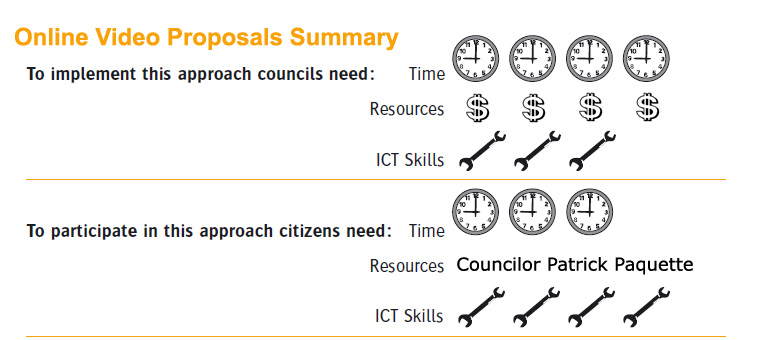 The potential for impact of this approach on:
Information EXTREME
Engagement EXTREME
Decision making EXTREME
Google this “video consultation”, “citizen journalism”, “political vlogs” “you tube” “ninety second challenge”
Conclusion - Meeting the digital challenge
E-democracy is of course just democracy with an additional letter appended to the front. Sometimes there is also no hyphen. As with the ‘electric’ typewriter, the “electronic” calculator or the “HD ready” TV, the appendage highlights a step-change in the product on offer. Sooner or later, if the product is strong enough and it is marketed effectively, it will be taken-up widely. With my team and I, Patrick Paquette, there will soon be many years of “e-democracy” in Ottawa, and we feel the time is approaching where it will just become “democracy”.
We are now in a digital society where technology is rapidly changing the way we live, work and play. The public expects information to be free and instantly available. The notion that democracy could be anything other than “e” is barely worth defending.
More than this, citizens of the digital world expect two-way communication. They increasingly expect to be able to produce as well as consume digital content and services. Through a renewed emphasis on inclusive digital democracy, as a way of meeting the digital challenge, we hope to create a product that is widely valued and taken up. Not because it has been marketed effectively but because democracy has become the co-product of authorities and citizens working together.